Cornell vs. Outline vs. Box vs. Mind Map: Which Note-Taking Method Should You Use?
Free spatial notes
Put this workflow on an infinite canvas instead of another linear doc.
Start in the browser with no account. Create an account only when you want to sync what you made.
Cornell vs. Outline vs. Box vs. Mind Map: Which Note-Taking Method Should You Use?
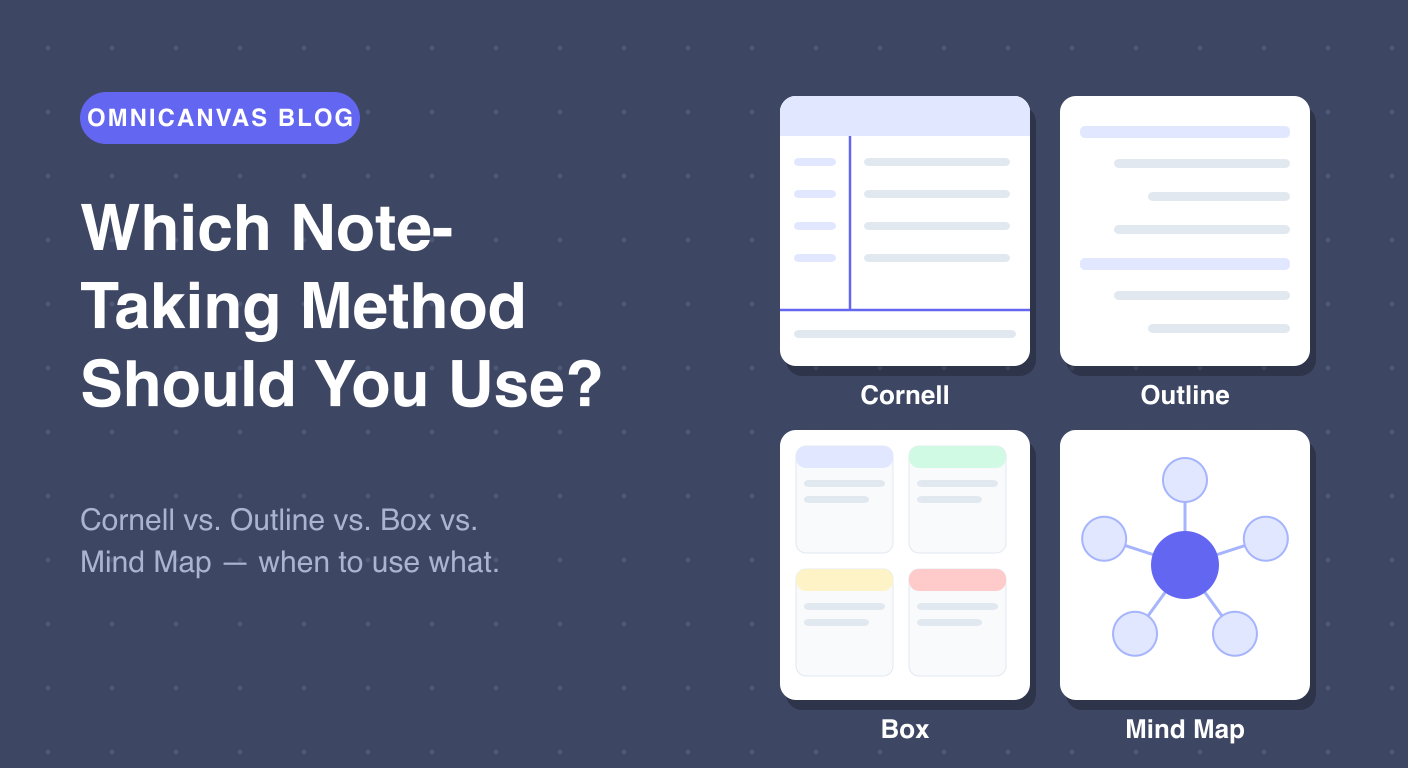
Search for "best note-taking method" and you will find a hundred articles ranking the same four systems, each crowning a different winner. They are all asking the wrong question. The four classic methods — Cornell, outline, box, and mind map — are not competitors. They are tools for different moments. The right question is not "which is best?" but "which is best right now?"
The Key Insight: Capture vs. Processing
Every note-taking situation is one of two modes:
Capture mode. Information is arriving in real time and your job is to not lose it. A lecture, a meeting, a phone call. Speed and completeness matter; understanding can wait.
Processing mode. The session is over. The information is captured, and your job is to make sense of it — find the structure, the connections, the implications. Now understanding is everything and speed is irrelevant.
Most note-taking failures come from using a processing method during capture (you fall behind and lose information) or a capture method for processing (you reread your notes, highlight them, and learn nothing). Match the method to the mode and everything clicks.
The Four Methods at a Glance
| Method | Mode | Best For | Weakness |
|---|---|---|---|
| Outline | Capture | Meetings, lectures, calls — anything live | Hides connections across topics |
| Cornell | Capture + built-in review | Lectures and courses you will be tested on | Needs follow-up to pay off |
| Box | Capture or processing | Parallel topics; consolidating messy notes | Awkward for deeply nested material |
| Mind Map | Processing | Making sense of material after the fact | Too slow for live capture |
During a Meeting or Class: Outline (or Cornell)
When someone is talking, use the outline method. It is the fastest structure there is — main topics at the margin, details indented beneath them — and it mirrors how speakers naturally organize what they say. You can keep up with almost anything without taking your eyes off the speaker.
If the material is something you will be tested on — a university course, a certification — use Cornell notes instead. The live capture works the same way (write in the notes column), but the layout reserves space for the review work you will do later, and that review is where the grade comes from.
Rule of thumb: meetings and one-off talks → outline. Courses and exams → Cornell.
Free spatial notes
Open a canvas in the browser — no account needed.
After the Meeting or Class: Mind Map
Within a day of the session — the sooner the better — spend ten minutes turning your captured notes into a mind map. Put the topic in the center, rebuild the main themes as branches from memory, then check your outline for what you missed.
This second pass is not busywork. It is where learning actually happens:
- Recalling the material from memory strengthens retention far more than rereading it.
- Rebuilding time-ordered notes as a radial map reveals connections the meeting itself never made explicit.
- Empty branches and unconnectable ideas show you exactly what you did not understand — while there is still time to ask.
The pairing is the point: outline during, mind map after. Capture fast, then process deliberately. Each method does what the other cannot.
For Consolidation and Study: Box Method
The box method earns its place in two situations:
Parallel material. When a day spans four meetings, or a chapter covers five unrelated concepts, give each one a labeled box. The boxes keep topics from bleeding into each other, and the spatial layout gives your memory extra hooks at review time.
The consolidation pass. At the end of a week, rewrite the stuff that still matters from all your outlines and mind maps into clean topic boxes. This weekly distillation is one of the highest-leverage study habits there is — and the box method is its natural format.
Putting It Together: A Complete Workflow
Here is what this looks like for a student (the work version is identical with "meeting" swapped in):
- In class → Cornell or outline template. Capture everything in the notes area. Do not organize, do not prettify.
- That evening → mind map template. Rebuild the lecture from memory as a map, then fill gaps from your notes. Write the Cornell cue questions and summary while you are at it.
- End of week → box method template. One box per topic covered this week, containing only what still matters. This page is what you study from.
- Before the exam → quiz yourself from Cornell cues and recall each box's contents before looking.
Every method appears exactly where it is strongest, and none of them is asked to do a job it is bad at.
Do It All in One Place
The reason we built all four of these as templates in OmniCanvas is that the workflow above falls apart when capture, processing, and consolidation live in different tools. On one infinite canvas, your outline, your mind map, and your topic boxes can sit side by side — you can literally drag a line from your outline into a mind map branch, and zoom out to see a whole course or project at once.
Open a free OmniCanvas canvas and you will find all four templates — Cornell Notes, Outline Method, Box Method, and Mind Map — under New from Template. Pick the one that matches the moment you are in right now, then create an account only if you want to sync it.
Ready to try spatial notetaking?
OmniCanvas is a free infinite canvas app for notes, sketches, and ideas. Start locally with no account.
Try OmniCanvas FreeSign up only when you want sync — or explore the interactive demo first.
Keep reading
The Outline Method: The Fastest Way to Take Notes in Meetings and Lectures
The outline method is the best technique for live capture — meetings, lectures and calls. How it works, when to use it, and how to start from a template.
KnowledgeHow to Find Hidden Connections in Your Notes
A practical method for spotting the links between notes you already have: repetition, different words for the same idea, and tension, plus tools that help.
TechniquesDesign Thinking on a Canvas: The Double Diamond Method
How to run the double diamond process — discover, define, develop, deliver — on an infinite canvas, with spatial layouts for each phase.