The Box Method: Note-Taking for People Who Think in Chunks
Free spatial notes
Put this workflow on an infinite canvas instead of another linear doc.
Start in the browser with no account. Create an account only when you want to sync what you made.
The Box Method: Note-Taking for People Who Think in Chunks
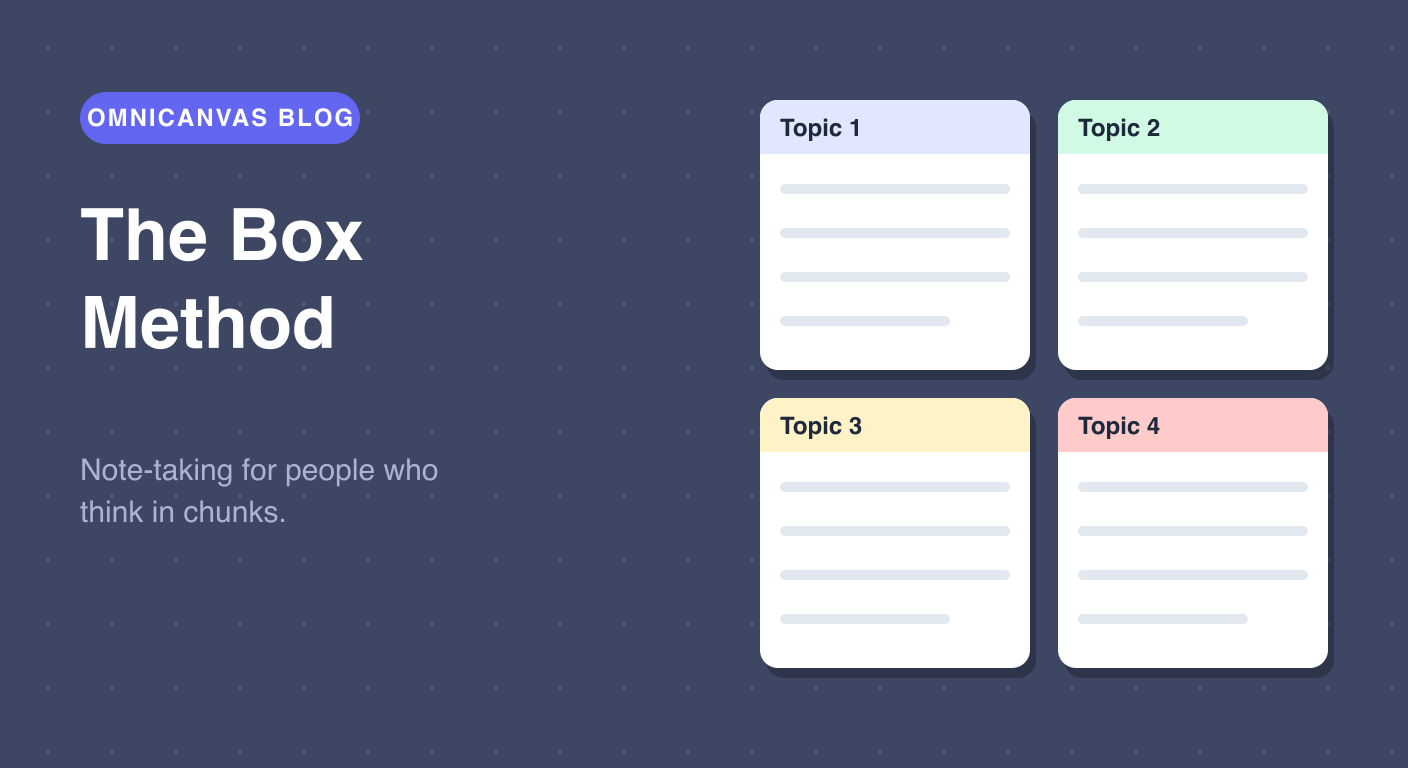
Some material does not arrive as a neat hierarchy. A day with four separate meetings. A textbook chapter covering five loosely related concepts. A language class introducing vocabulary, grammar, and culture notes all in one session. Forcing that into one linear page produces mush. The box method handles it by giving every topic its own home.
How the Box Method Works
The idea is almost embarrassingly simple:
- Draw a box for each distinct topic you expect to cover (or add boxes as topics come up).
- Label each box with its topic.
- Write notes for each topic inside its box — and only inside its box.
When the session is over, you have a page of self-contained, labeled chunks instead of one long stream where topics blur into each other.
Why Boxes Beat Lines for Certain Material
The box method exploits two well-documented properties of memory:
Chunking. Working memory handles roughly four to seven items at a time. Boxes pre-chunk your material: instead of remembering forty individual facts, you remember six boxes, each of which unlocks its contents.
Spatial memory. People remember where things were with surprising accuracy — which corner of the page, which side of the room. When your notes have a spatial layout, recall gets an extra retrieval path: "the verb conjugations were in the top-right box." A linear page gives you nothing like this.
Free spatial notes
Open a canvas in the browser — no account needed.
When to Use the Box Method
Boxing works best when:
- The material is parallel, not hierarchical. Several topics of similar importance, rather than one topic with sub-points.
- You are consolidating. Rewriting messy notes from a lecture or a week of meetings into clean, studyable chunks.
- You are comparing. One box per option, framework, or case study, laid out side by side.
- You study visually. If you remember pages by how they look, boxes give your memory strong anchors.
It is weaker for fast live capture (the outline method is better there) and for material with deep nesting. See the full comparison for how it stacks up against the Cornell method, outlining, and mind mapping.
The Box Method on an Infinite Canvas
The box method was always slightly awkward on paper — you have to guess how big each box should be before you know how much goes in it. Guess wrong and you are cramming words into corners.
On an infinite canvas, boxes grow. The Box Method template in OmniCanvas starts you with six labeled topic boxes in a grid. From there you can:
- Resize any box the moment a topic turns out to be bigger than expected.
- Add boxes when a new topic appears — the canvas never runs out of room.
- Color-code boxes by theme, urgency, or how well you know the material.
- Drag boxes around to put related topics next to each other after the fact.
- Drop images into boxes — a photo of the whiteboard goes in the box for that discussion.
A Simple Box Method Workflow
- Open OmniCanvas with the Box Method template — it opens a local note with the box grid ready.
- Rename each box header to a topic you are covering today.
- Take notes inside the boxes as you go, or rewrite your rough notes into boxes afterward as a consolidation pass.
- At review time, read one box at a time. Cover it, recall what it contains, then check.
The box method is the least famous of the major note-taking systems, but for parallel topics and visual learners it routinely beats its better-known cousins.
Try the Box Method template in OmniCanvas
Open a local canvas with the Box Method layout ready to go — no setup or account needed.
Use the Box Method TemplateStart locally, then sign up only to sync — or explore the interactive demo first.
Keep reading
SWOT Analysis on an Infinite Canvas: A Visual Strategy Tool
How to run a SWOT analysis (Strengths, Weaknesses, Opportunities, Threats) on a spatial canvas, with tips for adding depth beyond the basic quadrant.
TechniquesDesign Thinking on a Canvas: The Double Diamond Method
How to run the double diamond process — discover, define, develop, deliver — on an infinite canvas, with spatial layouts for each phase.
TechniquesHow to Create a Digital Vision Board on an Infinite Canvas
How to create a digital vision board combining images, text, goals and affirmations on a spatial canvas. More flexible than a physical board.