SWOT Analysis on an Infinite Canvas: A Visual Strategy Tool
Free, no account
Put this on an infinite canvas — open one free, right now.
Notes, sketches, and ideas anywhere on the canvas, in your browser. Sign up only when you want it synced.
Free forever · 30 days of Pro when you sign up
SWOT Analysis on an Infinite Canvas: A Visual Strategy Tool
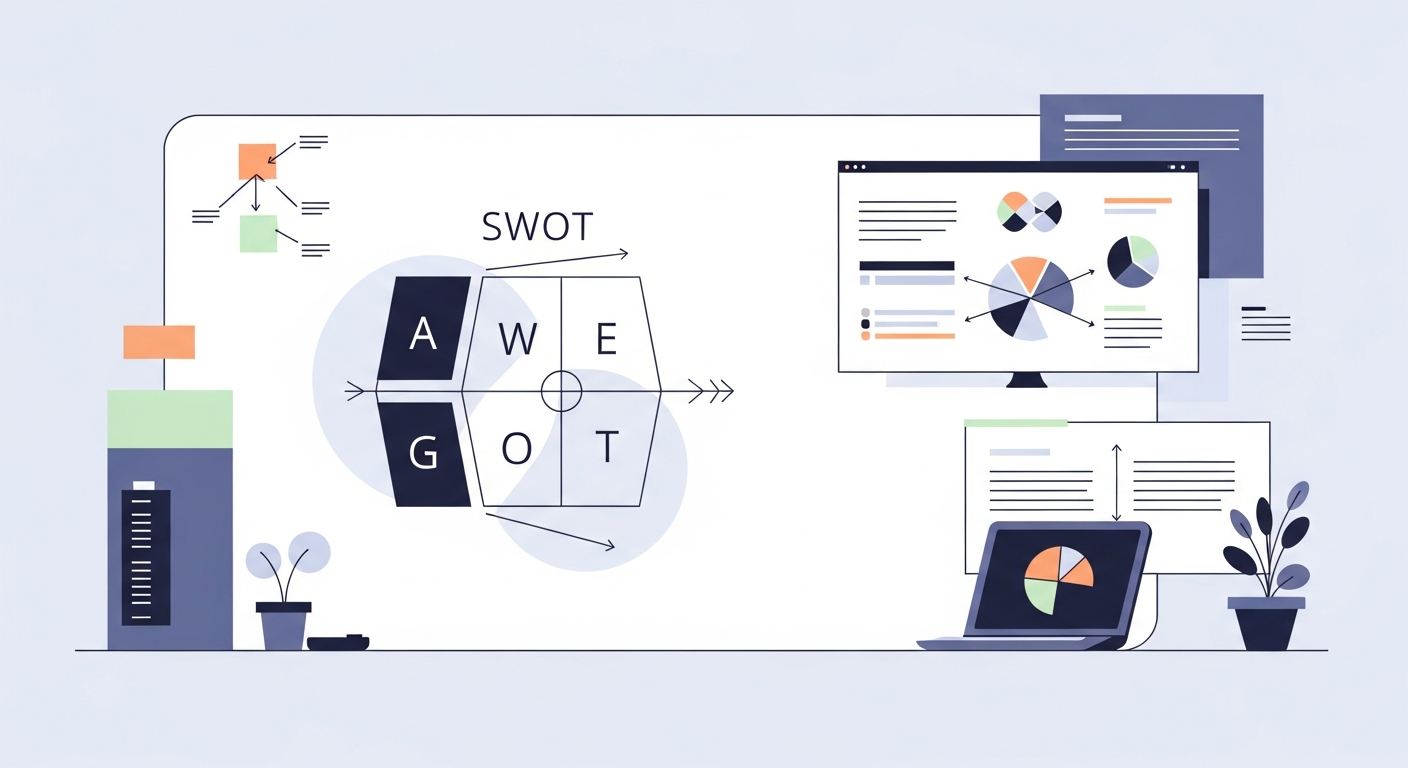
SWOT analysis is one of the most widely used strategic planning tools in business, and for good reason — it forces you to think systematically about your position before making decisions. But the typical SWOT is a static grid on a whiteboard or slide deck that gets created once and never revisited. Running your SWOT on an infinite canvas transforms it from a one-time exercise into a living strategic document.
The Basics of SWOT
SWOT examines four dimensions of any project, product, organization, or decision:
- Strengths — Internal advantages. What do you do well? What unique resources do you have? What do others see as your strengths?
- Weaknesses — Internal disadvantages. Where do you fall short? What do you lack? What do competitors do better?
- Opportunities — External favorable factors. What trends could you capitalize on? What gaps exist in the market? What changes in technology or regulation create openings?
- Threats — External unfavorable factors. What obstacles do you face? What are competitors doing? What economic, regulatory, or technological changes could hurt you?
Strengths and Weaknesses are internal — things you control. Opportunities and Threats are external — things happening around you.
Setting Up the Canvas
Create the classic four-quadrant grid at the center of your canvas:
- Top-left: Strengths (green background)
- Top-right: Weaknesses (red or orange background)
- Bottom-left: Opportunities (blue background)
- Bottom-right: Threats (yellow background)
But here is where the canvas approach diverges from the typical whiteboard. You are not limited to that grid. The quadrants are the starting point, not the whole analysis.
Populating Each Quadrant
For each quadrant, create individual cards rather than a single bulleted list. One card per point. This is important because you will later rearrange, connect, and prioritize these cards.
When brainstorming Strengths, ask:
- What do our customers praise most?
- What processes work exceptionally well?
- What expertise or talent do we have that is hard to replicate?
- What financial or physical resources give us an advantage?
For Weaknesses:
- What complaints do we hear repeatedly?
- Where do we lose deals to competitors?
- What skills or resources are we missing?
- What processes are inefficient or fragile?
For Opportunities:
- What industry trends are accelerating?
- What customer needs are underserved?
- What partnerships could amplify our strengths?
- What new technologies could we adopt?
For Threats:
- What are competitors launching?
- What regulations might affect us?
- What economic conditions could impact demand?
- What single points of failure exist in our supply chain or team?
Aim for at least five to eight cards per quadrant. The first few are obvious. Push past them. The non-obvious items are often the most strategically valuable.
Free, no account
Open a canvas in the browser — no account needed.
Going Beyond the Basic Grid
This is where the infinite canvas earns its keep. Expand outward from the four quadrants to add depth that a basic SWOT never captures.
Priority ranking. Within each quadrant, arrange cards vertically by importance. The most significant strengths go at the top. The most dangerous threats go at the top. Now you have not just a list but a prioritized list, and the priority is communicated visually.
Cross-connections. Draw lines between cards in different quadrants. A Strength that directly addresses a Threat gets a connecting line. An Opportunity that could mitigate a Weakness gets one too. These connections reveal your strategic options:
- Strength plus Opportunity equals an aggressive strategy — leverage what you are good at to seize the opportunity.
- Strength plus Threat equals a defensive strategy — use your advantages to protect against the threat.
- Weakness plus Opportunity equals an improvement strategy — invest in fixing the weakness to capture the opportunity.
- Weakness plus Threat equals a contingency — this is your danger zone, plan for it.
Action items. For each cross-connection, place an action card nearby. What specifically will you do about it? Who owns it? By when? These action cards transform the SWOT from an analysis exercise into an execution plan.
Evidence and data. Next to each card, place supporting evidence — a customer quote, a sales number, a market report excerpt. On an infinite canvas, you have room for all of this without cluttering the main grid. Place evidence just outside the quadrant, connected to the relevant card. OmniCanvas lets you zoom in to see the details and zoom out to see the big picture.
Running a SWOT Workshop on the Canvas
If you are facilitating a team SWOT, the canvas approach works well:
- Individual brainstorming (10 minutes). Each participant adds cards to the quadrants. No discussion yet, just capture.
- Clustering (10 minutes). Group similar cards together. Merge duplicates. You will find that multiple people identified the same strength or threat, which is itself useful information — it confirms those items are real.
- Prioritization (10 minutes). As a group, arrange cards within each quadrant by importance. This often generates the most valuable discussion of the session.
- Cross-connection (15 minutes). Draw lines between quadrants. Identify the strategic combinations described above.
- Action planning (15 minutes). Assign specific actions to the highest-priority connections.
Keeping the SWOT Alive
The biggest failure mode of SWOT analysis is doing it once and forgetting about it. On a canvas, you can prevent this:
Review monthly. Spend fifteen minutes revisiting the canvas. Have any Threats materialized? Have new Opportunities appeared? Move cards, add new ones, archive outdated ones.
Track progress on actions. The action cards you placed around the grid should have status indicators. Update them regularly. A SWOT that generates actions and tracks them is worth ten times more than one that sits in a presentation deck.
Layer over time. Keep old versions of the SWOT visible on a distant part of the canvas. Comparing this quarter's SWOT to last quarter's reveals trends that a single snapshot never could.
When to Use SWOT
SWOT is versatile enough for almost any strategic decision: launching a product, entering a market, evaluating a career change, planning a project, or assessing an organization. The framework is simple enough that anyone can participate, which makes it excellent for cross-functional teams. And when you run it on a spatial canvas, it becomes not just an analysis but a strategic dashboard that grows more valuable over time.
Related: a SWOT is one piece of organizing notes when you have too many — build yours on the free whiteboard.
Ready to try spatial notetaking?
OmniCanvas is a free infinite canvas app for notes, sketches, and ideas. Start locally with no account.
Try OmniCanvas FreeSign up only when you want sync — or explore the interactive demo first.
Keep reading
How to Create a Digital Vision Board on an Infinite Canvas
How to create a digital vision board combining images, text, goals and affirmations on a spatial canvas. More flexible than a physical board.
TechniquesThe Eisenhower Matrix on a Canvas: Prioritize What Actually Matters
How to create a visual Eisenhower matrix (urgent/important grid) on an infinite canvas for task prioritization. Includes setup and daily workflow.
TechniquesDesign Thinking on a Canvas: The Double Diamond Method
How to run the double diamond process — discover, define, develop, deliver — on an infinite canvas, with spatial layouts for each phase.