Design Thinking on a Canvas: The Double Diamond Method
Free, no account
Put this on an infinite canvas — open one free, right now.
Notes, sketches, and ideas anywhere on the canvas, in your browser. Sign up only when you want it synced.
Free forever · 30 days of Pro when you sign up
Design Thinking on a Canvas: The Double Diamond Method
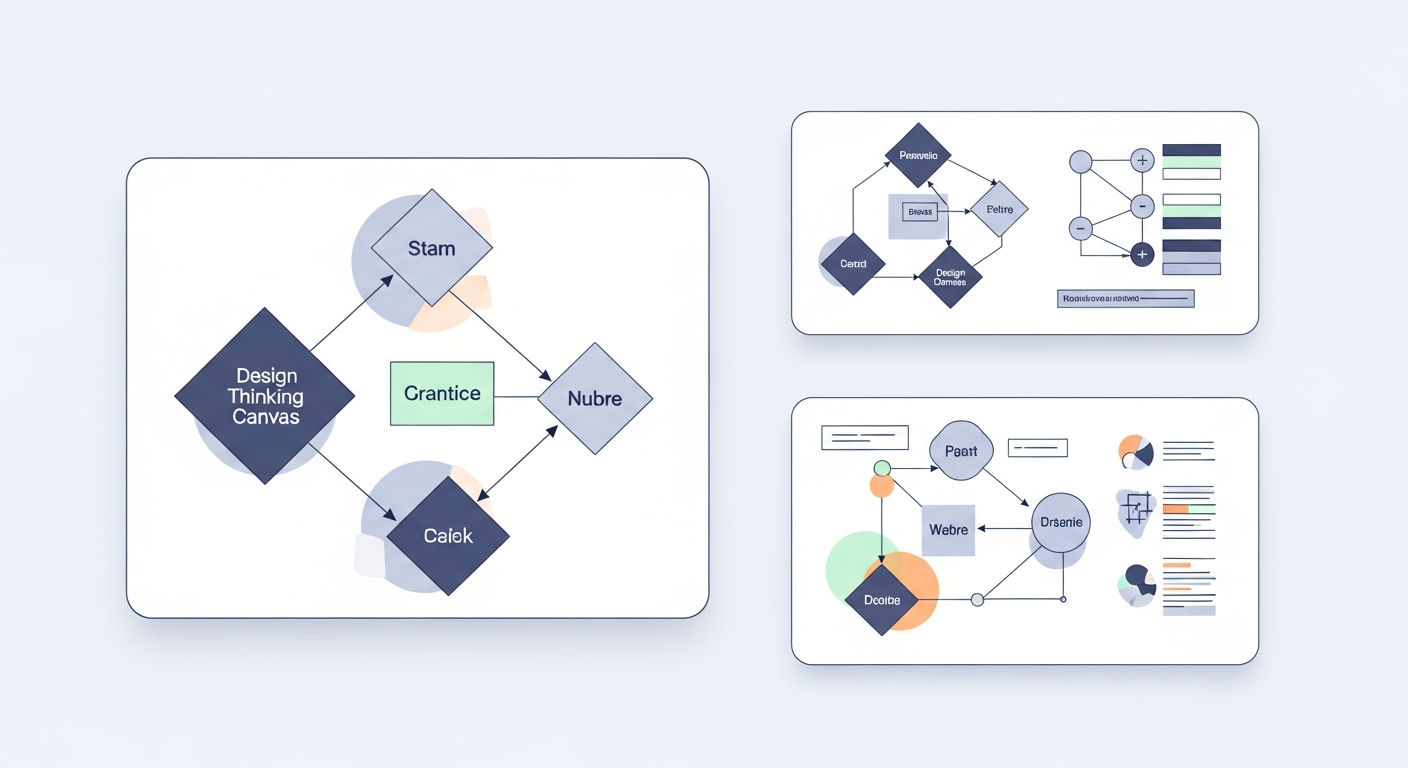
The Double Diamond is one of the most widely used design thinking frameworks. Developed by the British Design Council, it divides the design process into four phases that alternate between divergent and convergent thinking. An infinite spatial canvas is the ideal surface for this method because the diamond shapes map naturally to how ideas expand and contract across the canvas.
Understanding the Double Diamond
The framework has two diamonds, each with a divergent phase (expanding possibilities) and a convergent phase (narrowing focus):
Diamond 1: The Problem Space
- Discover (diverge) — Research broadly, gather insights, explore the problem from many angles.
- Define (converge) — Synthesize research into a clear problem statement or design brief.
Diamond 2: The Solution Space
- Develop (diverge) — Generate many possible solutions, brainstorm freely, prototype ideas.
- Deliver (converge) — Refine, test, and implement the best solution.
The key insight is that you must fully explore the problem before jumping to solutions. Most failed projects skip the first diamond entirely.
Setting Up the Canvas Layout
Lay out your canvas from left to right in four zones. The spatial width of each zone should reflect the divergent or convergent nature of that phase.
Discover Zone (wide). This zone fans out. Place research notes, interview snippets, observation cards, data points, competitor analyses, and user quotes here. Spread them out. The visual sprawl reflects the breadth of your research.
Define Zone (narrow). This zone funnels down to a single, clear problem statement. Place synthesis tools here: affinity clusters, insight statements, personas, and ultimately the problem brief. The narrowing is visible in how the content compresses.
Develop Zone (wide again). This zone fans out once more. Place brainstorming output, sketches, "how might we" questions, concept cards, and rough prototypes here. Again, spread things wide.
Deliver Zone (narrow). This zone converges to the final solution. Place evaluation criteria, test results, refined prototypes, and implementation plans here. Everything tightens toward the finished product.
A thin vertical line or color change between each zone helps you see the phase boundaries at a glance.
Free, no account
Open a canvas in the browser — no account needed.
Working Through the Discover Phase
Start by placing everything you learn about the problem onto the canvas in the Discover Zone. Each piece of research gets its own card:
- User interview notes — one card per key insight or quote
- Observation notes — things you noticed watching people interact with the current solution
- Data points — statistics, survey results, analytics
- Competitor examples — screenshots or descriptions of how others address this space
- Stakeholder perspectives — what different people in the organization think the problem is
Do not organize yet. Just get everything onto the canvas. The messiness is intentional. Premature organization kills discovery.
Moving to the Define Phase
Now shift into convergent mode. Start grouping the Discover cards into clusters. Look for patterns. Which insights reinforce each other? Where do multiple data points tell the same story?
Create affinity groups by dragging related cards together and giving each group a label. From these groups, write insight statements: observations about user needs or behaviors that suggest design opportunities.
Synthesize everything into a problem statement. A good format is: "Users need a way to [user need] because [insight], but currently [barrier]." Place this statement prominently at the narrowest point of Diamond 1, where it bridges into Diamond 2.
The Develop Phase
With a clear problem statement, open up the canvas again. This is where you generate solutions — as many as possible. Quantity matters more than quality at this stage.
Effective techniques for the Develop Zone include:
- Brainwriting. Each team member adds ideas as separate cards on the canvas. No discussion yet, just generation.
- How Might We questions. Convert the problem statement into multiple "how might we" prompts. Each prompt suggests a different angle of attack.
- Concept sketches. Rough visual ideas placed directly on the canvas. On OmniCanvas, you can draw these directly on the surface alongside your text notes.
- Analogous inspiration. How do other industries solve similar problems? Place examples from unrelated fields on the canvas.
- Crazy eights. Eight ideas in eight minutes, each on its own card.
Arrange ideas loosely. Let related concepts drift near each other, but do not force structure yet.
Converging to Deliver
Now evaluate. Create a simple scoring framework on the canvas — perhaps a set of criteria cards (feasibility, desirability, viability) with a scale. Drag each concept near its scores or use color to indicate strength.
Select the most promising two or three concepts and expand them. For each, create a more detailed card covering:
- How it works
- Key assumptions to test
- Biggest risk
- Simplest prototype you could build
Test your prototypes with users. Place the feedback directly on the canvas next to the concept it relates to. Iterate. The final solution emerges from this cycle of prototyping and feedback, narrowing toward the rightmost edge of your canvas.
Tips for Facilitating This With a Team
Assign zones. In a workshop, give each person a color and have everyone add cards to the same canvas simultaneously. The collaborative nature of a shared canvas prevents one voice from dominating.
Time-box each phase. Divergent phases should feel uncomfortable — push past the obvious ideas. Convergent phases need discipline — actually commit to narrowing down.
Preserve the journey. One of the biggest advantages of doing a Double Diamond on a canvas is that the whole process remains visible. When someone questions a decision during Deliver, you can zoom back to Discover and show the research that led here. The canvas becomes a living record of your design rationale.
Use the infinite space. Do not try to fit everything into one screen. The whole point of an infinite canvas is that you can spread out during divergent phases and zoom in during convergent ones. Let the spatial layout breathe.
Why the Canvas Matters
The Double Diamond is fundamentally about the shape of thinking — expanding and contracting. Linear documents force your ideas into a sequence that obscures this shape. A spatial canvas makes it visible. You can literally see whether you are diverging or converging, whether you have enough research or not enough ideas, whether your final solution connects back to real user needs. That visibility is what turns design thinking from an abstract framework into a practical, repeatable process.
Related: keep your process alongside everything else when organizing notes when you have too many — run each phase on the free whiteboard.
Ready to try spatial notetaking?
OmniCanvas is a free infinite canvas app for notes, sketches, and ideas. Start locally with no account.
Try OmniCanvas FreeSign up only when you want sync — or explore the interactive demo first.
Keep reading
How to Create a Digital Vision Board on an Infinite Canvas
How to create a digital vision board combining images, text, goals and affirmations on a spatial canvas. More flexible than a physical board.
TechniquesSWOT Analysis on an Infinite Canvas: A Visual Strategy Tool
How to run a SWOT analysis (Strengths, Weaknesses, Opportunities, Threats) on a spatial canvas, with tips for adding depth beyond the basic quadrant.
ContentBuilding a Course Curriculum on an Infinite Canvas
How educators and course creators plan curriculum, organize modules, map learning objectives, and design assessments on a spatial canvas.