Mind Mapping vs. Spatial Notetaking: Which Is Better for You?
Free, no account
Put this on an infinite canvas — open one free, right now.
Notes, sketches, and ideas anywhere on the canvas, in your browser. Sign up only when you want it synced.
Free forever · 30 days of Pro when you sign up
Two Visual Approaches, Different Strengths
Mind mapping and spatial notetaking are both visual methods for organizing information, but they work very differently. Understanding these differences helps you choose the right approach — or combine them effectively.
What Is Mind Mapping?
A mind map starts with a central topic and branches outward in a radial tree structure. Each branch represents a sub-topic, which can branch further into details. The result looks like a tree or a spider web radiating from the center.
Mind mapping was popularized by Tony Buzan in the 1970s. Key characteristics:
- Single root node. Every mind map has one central concept.
- Hierarchical branches. Ideas flow from general (center) to specific (edges).
- Radial layout. Branches extend outward in all directions.
- Keywords over sentences. Mind maps favor short labels over full text.
- Color and images. Good mind maps use color-coding and small icons.
What Is Spatial Notetaking?
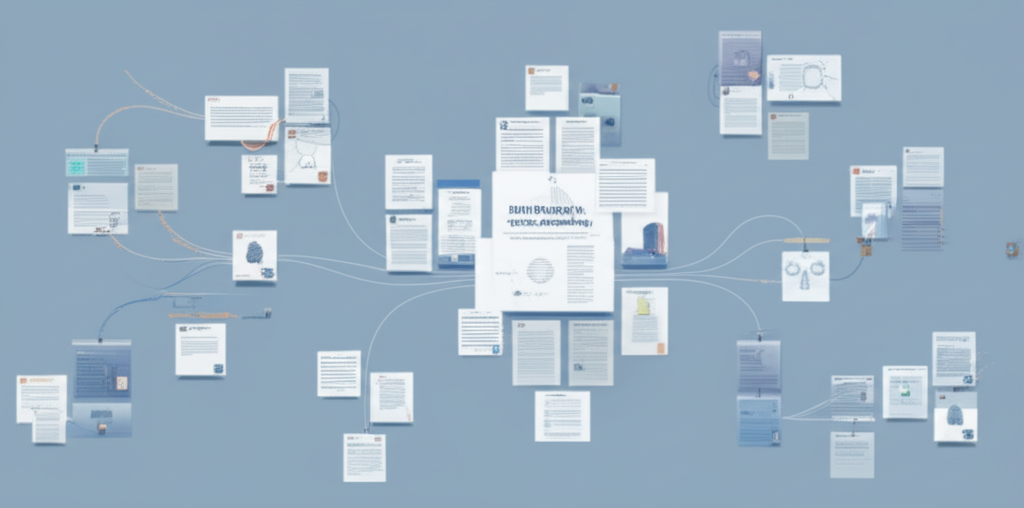
Spatial notetaking places notes, images, and drawings freely on a two-dimensional canvas with no required structure. You can arrange content however you want — in clusters, grids, timelines, or scattered randomly.
Key characteristics:
- No required structure. You decide the layout.
- Multiple focal points. There is no single center — many clusters can coexist.
- Full text and media. Notes can contain paragraphs, images, and drawings.
- Free-form connections. You can draw lines between any items.
- Infinite canvas. No space limits.
Key Differences
Structure vs. Freedom
Mind maps impose a hierarchical structure. This is helpful when your topic naturally fits a tree shape (organizational charts, taxonomies, outlines). But it is limiting when your ideas don't have a clear hierarchy — when relationships are more network-like than tree-like.
Spatial notetaking imposes no structure, giving you complete freedom. This is great for brainstorming and exploration, but can feel overwhelming if you need a clear organizational framework.
Free, no account
Open a canvas in the browser — no account needed.
Single Topic vs. Multiple Topics
A mind map is about one central topic. If you want to explore the relationships between multiple topics, you either need multiple mind maps or the branches become awkward.
Spatial notes handle multiple topics naturally. You can have clusters for different topics on the same canvas and draw connections between them.
Quick Capture vs. Rich Content
Mind maps favor brevity — single words or short phrases on each branch. This makes them fast to create but limited in detail.
Spatial notes accommodate rich content — full paragraphs, images, drawings, embedded files. This makes them better for detailed notes but slower to create.
Recall vs. Discovery
Mind maps are excellent for memorization and recall. The hierarchical structure and visual layout help you remember information systematically.
Spatial notes are better for discovery and creativity. The free-form layout encourages unexpected connections between ideas.
When to Use Mind Mapping
- Studying for exams. The hierarchical structure helps you organize and memorize course material.
- Summarizing a book or article. The tree structure maps well to chapter and section organization.
- Planning a presentation. The branches become your outline, with key points on each branch.
- Brainstorming around a single question. When you have one clear topic to explore, mind mapping provides useful structure.
When to Use Spatial Notetaking
- Planning a complex project. Multiple workstreams, stakeholders, and dependencies are better represented spatially.
- Research across multiple sources. Place findings from different sources as separate clusters and connect them.
- Creative brainstorming. When you need maximum freedom and don't want structure constraining your ideas.
- Building a personal knowledge base. A second brain with interconnected topics works better on a spatial canvas.
- Meeting notes. Capture discussion topics, decisions, and action items as separate elements, clustered by theme.
Combining Both Approaches
The best approach is often to use both. Here is how:
- Start with spatial notetaking to capture ideas freely during brainstorming or research.
- Switch to mind mapping when you need to organize those ideas into a coherent structure.
- Return to spatial notes to add detail, context, and connections between your organized topics.
On an infinite canvas app like OmniCanvas, you can do both on the same surface — create a mind map in one area and have free-form spatial notes in another, drawing connections between them. Try it on a free online whiteboard.
The Bottom Line
Mind mapping is better for structured, hierarchical, single-topic thinking. Spatial notetaking is better for unstructured, networked, multi-topic thinking. Most people benefit from both, using the right approach for the right task.
If you had to pick one, spatial notetaking is more versatile — you can always create a mind map on a spatial canvas, but you can't easily do free-form spatial notes in a mind mapping tool. Learn more in our complete guide to the infinite canvas.
Ready to try spatial notetaking?
OmniCanvas is a free infinite canvas app for notes, sketches, and ideas. Start locally with no account.
Try OmniCanvas FreeSign up only when you want sync — or explore the interactive demo first.
Keep reading
Visual Project Management: Kanban Boards vs. Spatial Canvases
Compare kanban boards and spatial canvases for project management. When each approach works best and how to combine them.
GuidesWhat Is Spatial Notetaking? A Complete Guide for 2026
Spatial notetaking places ideas on an infinite 2D canvas instead of a linear document. How this approach unlocks better thinking, recall and creativity.
TechniquesCornell vs. Outline vs. Box vs. Mind Map: Which Note-Taking Method Should You Use?
A practical guide to choosing between the Cornell method, outline method, box method and mind mapping — plus the capture-then-process workflow.